For two hours of your weekly teaching schedule, your school can timetable you in to give classes to the teaching staff (and indeed anyone in the school who would benefit from improved English language skills). While this could potentially feel awkward for the teaching Auxiliar, I’ve found them the most fun and rewarding. This is largely because your students are arguably the most motivated an invested you’ll have – by virtue of having opted in to the classes. The smaller class size also makes them much more manageable, flexible and with more scope to react to the needs of each ‘student’.
My teacher-students we’re keen to use the time for conversation practice, so I usually devise very loose lessons that enabled this. Often its a theme that lends itself to a particular grammar point. And if I identify a problem area (grammatically) I can search for exercises to help and maybe focus on that again in the subsequent classes.
Perhaps best of all, the ‘opt-in’, collegial nature of these classes enabled me to set up an email group to which I send summaries of the lesson, with more in-depth explanations, links to useful Youtube videos, further practices exercises etc. This has given the lessons a more substantive feel than they otherwise may have had – and allows busy teachers (who may have had to skip a class) a chance to stay involved and perhaps consolidate in their own time.
During each class, I write up verbs, phrases, vocabulary etc on the board. At the end of the lesson, I take a photo with my phone and use this as the basis for my follow up email. Below is an sample of the emails I have produced.
Lesson One
Hi everyone!
(Hay una version español abajo 😉
It was great to met you all last week. Here is a summary of the lesson. (I’m going to send an email like this each week.) If you have any questions during the week you can contact me via this email address or via WhatsApp (+44 78xxxxxxxx). Equally, if there is anything particular you would like to work on during our lesson, let me know. 🙂
Fue genial conoceros la semana pasada. Aquí hay un resumen de la clase. (Voy a enviar un correo electrónico como este cada semana). Si tengáis alguna pregunta durante la semana, podéis avisarme por esta dirección de correo electrónico o por WhatsApp (+44 78xxxxxxxx). Igualmente, si hay algo en particular que os gustaría tocar/cubrir (?) durante nuestras clases, avísame también. 🙂
Introducing yourself.
(No os preocupáis mucho por las palabras entre paréntesis – solo están allí para anadir información/ explicación )
Hi. My name is Pete. I’m 41 years old. (I have 41 years)
I’m from Manchester, but I was born in Carlisle.
I moved to Manchester in 2002. (past simple – ‘I moved’)
I live in Manchester.
– (we use present simple – ‘I live’ – for permanent facts)
I’m living in Madrid until the end of June.
– (we use present continuous – ‘I am living’ – for temporary situations)
I’m a writer, but right now I’m working as a teaching assistant.
I’m single. ( / married / divorced / engaged / retired ).
In my free time I play the piano and go running.
– (we use present simple – ‘I play’ and ‘ I go’ – for habits and routines)
My favourite country is Japan. I have visited Tokyo 3 times.
(we use present perfect – ‘I have visited’ – to talk about a period of time that continues from the past up to now)
verbs
to be born – nacerto live – vivirto be – ser /estarto study – estudiarto move – mudarseto have – tenerto work – trabajarto visit – visitarto play – tocar
Remember:X What do you study? X > What are you studying?X Where have you born? X > Where were you born?X I don’t visit New York. X > I have never visited New York.
2019 can be pronounced “two-thousand and nineteen” or “twenty-nineteen”.
See you all on Wednesday!
Best regards,
Pete
Lesson Two
.
Hi everyone!
Here is a reminder of what we covered in our last lesson.
The future
Cuando hablas sobre el futuro, hay varias formas de frases que puedas usar. Me parece que sabéis la forma will + INFINTIVE
e.g. Tomorrow I will make a cake for Pete’s birthday.
(Mañana haré una tarta para el cumpleaños de Pete.)
Pero de hecho, es mas seguro usar la forma to be + going to + INFINITIVE
e.g. Next week I am going to visit a museum.
(La semana que viene, voy a visitar un museo.)
Recuerda que tienes que conjugar ‘to be’ en el present simple:
I am going to visit a museum.
You are going to visit a museum.
He is going to visit a museum.
We are going to visit a museum.
They are going to visit a museum.
El dibujo ajunto explica la diferencia entre las dos formas.
.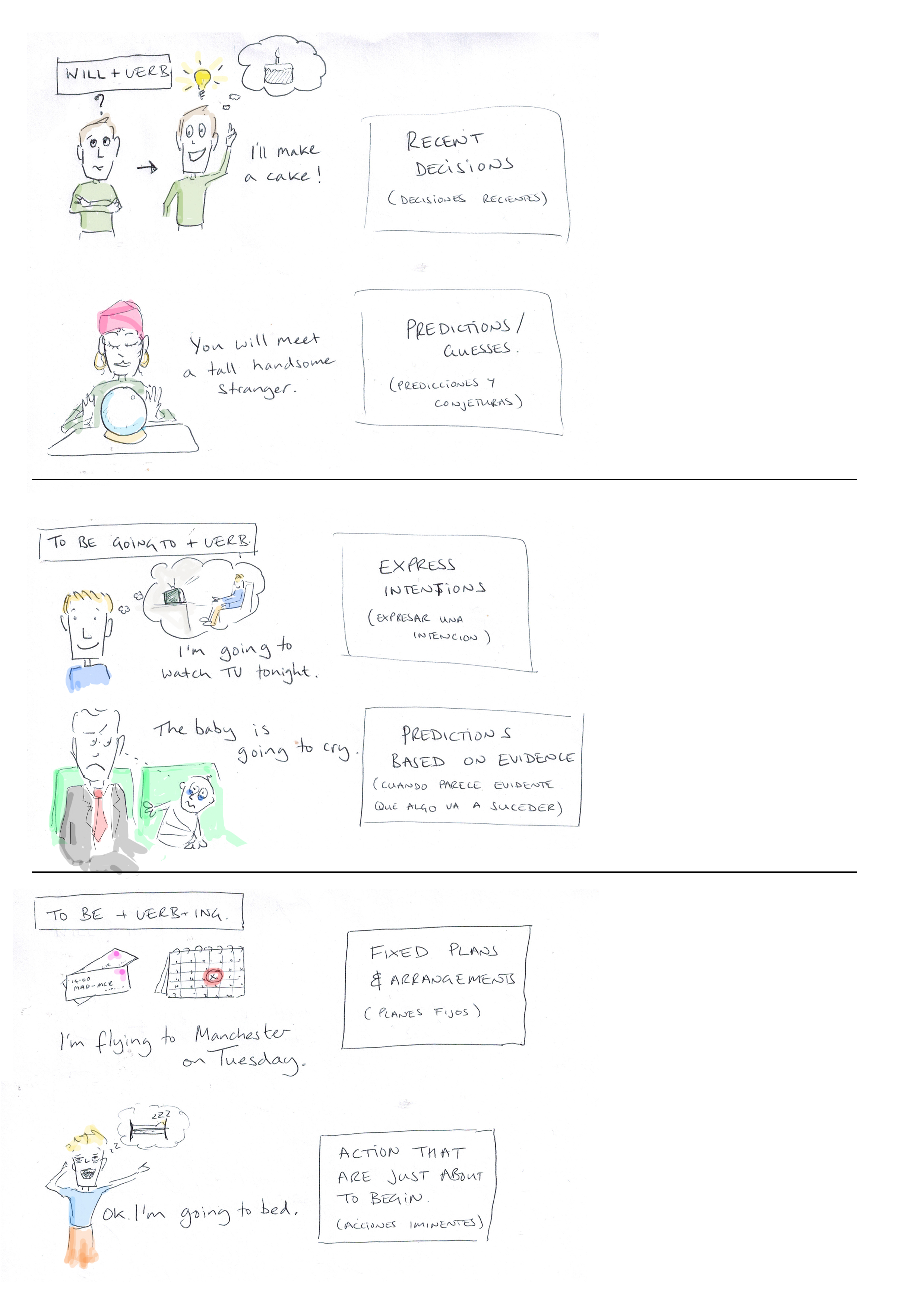
(Img: Pete Brewis)
Verbs
to get on – llevarse bien
to be born – nacer
to dress up – disfrazarse
to borrow – pedir prestar
to lend – prestar
Phrases and vocabulary
I’m coming! – ¡Ya voy!
How’s your week going? – ¿Cómo va tu semana?
(It’s) your turn – te toca
She lives on her own – vive solo
I live on my own – vivo solo
(tennis / squash / badminton / basketball / padel) court – pista
(football / hockey / rugby) pitch – campo
a view – una vista
a viewpoint / lookout – un mirador
go cycling
go swimming
go running
go shopping
a costume – un disfraz
See you on Wednesday!
Pete
Lesson Three
Hi,
Here is a recap of the last two lessons. Please forward on this email to anyone else in the group who might want it.If you would like to receive this email directly, please send me your direct/personal email address.{Aquí hay un resumen de las últimas dos clases. Por favor, reenvíe este correo electrónico a cualquier otra persona del grupo que no haya recibido.Si desea recibir este correo electrónico directamente, envíeme su dirección de correo electrónico directa / personal.}
THE FUTURE:
will + VERB
– recent decision
(e.g. ” I’ll make a cake for Pete.”)
– predictions / guesses (with no evidence).
(e.g. “In the year 3000, everyone will own flying cars.”)
[am / are / is] + going to + VERB
– express intentions
(e.g. “I’m going to watch TV tonight.”)
– predictions based on evidence
(e.g. “Look at those black clouds! It‘s going to rain“)
[am / are / is] + VERB+ing (the future using present continuous)
– to talk about fixed arrangements/plans with other people.
(e.g. “I can’t come to your party on Saturday; I‘m visiting my friend in Malaga.”)
– to talk about something that is about to start imminently
(e.g. “I‘m going to bed. Goodnight!”)
Verbs
to think up – inventar
to slide – deslizarse
to campaign – hacer campaña
irregular verbs
(verb – past simple – past participle)
slide – slid – slid
eat – ate – eaten
sleep – slept – slept
think – thought – thought
read – read* – read* (pronounced “red”)
sing – sang – sung
Phrases and vocabulary
My phone is on ‘silent’
My phone is on ‘vibrate’
a recital – recital / recitación
a talk – una charlacostal road
I live near of the school (puedes decir “near to the school” también, pero es menos común)
poverty – la pobrezaski
slope – la pista de esquí
See you tomorrow!
Pete
Lesson Six
Hi everyone,
Last lesson we practised the past simple… including the correct pronunciation.
—
PAST SIMPLE:
regular verbs:
VERB+ed
e.g. “I jumped into the pool.”
Remember:
• y -> i (e.g. hurry -> hurried )
• Consonant-vowel-consonant => double the last letter (e.g. stop -> stopped)
irregular verbs:
e.g. “I drove my car into a tree.” (The past simple of the verb ‘to drive’.)
pronunciation
For regular verbs, the ‘ed‘ ending is pronounced in three different ways.
‘ed’ is pronounced / t / for unvoiced sounds (sonidos sin voz):e.g.washed, talked, watched
‘ed’ is pronounced / d / for voiced sounds (sonidos con voz)e.g lived, played, cried
‘ed’ is pronounced / id / for verbs that end in a t or d sound (terminan con el sonido ‘t’ o ‘d’ )e.g. hated, wanted, added. (Notad: no es que la palabra termine con la letra ‘t’ o ‘d’ – mejor dicho que tenga el sonido de ‘t’ o ‘d’. Por ejemplo, el verbo “hate” termina con ‘e’, pero el sonido es ‘t’)
A mi, los sonidos / t / y / d / son muy similar. Lo mas importante es que estos dos no tienen una sílaba. (Pero con la terminación / id /, se ánade una sílaba).
A 3 minute video explanation in English:
https://youtu.be/-QEFgKIyy_Y
A video explanation in Spanish (empieza 3m05s):
https://youtu.be/2wdHinJh8no?t=176
—
Phrases and vocabulary
a nephew – sobrinoa niece – sobrina (no existe una palabra ‘sobrinos’ en ingles!)a nap – cabazadanod off – cabecar
during [something] – e.g. “I slept during the movie.” for [a length of time] – e.g.”I slept for 30 minutes.” sign up (for something) – e.g. “I’ve signed up for yoga lessons”Queen Elizabeth II = “Queen Elizabeth the second”to lie – mentirmark / grade – calificar / corregir
—
Irregular verbs
send – sent
be – was
swim – swam
freeze – froze
sleep – slept
do – did
—
That’s everything!
See you tomorrow. 🙂
Pete.
)
[5] Big plastic folders
This is more for you than the students. If you plan to get creative and use lots of materials with ‘bits’, then do yourself a favour and buy a stack of plastic wallet folders. The ones pictured are ideal – big enough to hold the wipe-clean album boards (see number 1) and with a button clip to keep it falling out all over the place. (I originally would put things in plastic ring binder wallet and would arrive in class to find them tipped all over the inside of my bag.)
 TEACHER PETE