Lesson aims:
Students learn how to construct passive sentences and get an understanding for how they compare to active sentences.
Quick description: Using facts about iconic Spanish buildings, students learn how to construct passive sentence. Students first identify the Spanish buildings and get some conversation practice as they discuss their knowledge of these buildings – first in pairs, then as a class. Student then see an example fact in the active voice and see how it can be converted into the passive voice. Following this example, they fill the blanks to complete further facts about the buildings pictured. Finally they convert the passive sentences into the active voice. (In doing so, highlighting how the passive is useful when we don’t know the who has done an action, or we don’t want to say, or it isn’t important.)
Sub-skills practised: quick practice of present continuous (I have never visited the Sagrada Familia / I have visited it twice etc), conversation practice -giving opinions (I like it because… etc).
Teaching Materials / requirements:
• Power point presentation • Power point presentation
• A projector
• list of additional facts (in active) for fast finishers to convert to passive
DOWNLOAD LINKS: word doc of lesson plan • powerpoint template • youtube video of presentation
Preparation:
- Make a note of / print out extra facts (in active voice) for fast finishers.
Assumed knowledge:
Students have some knowledge of the past tense (for discussions of the buildings pictured). Knowledge of the present simple structure of subject – verb – object.
Anticipated problems > solutions:
- Technology fail – For the initial stages, if there is no projector, the students might enjoy your attempts to draw the buildings on the board yourself! Or ask a good student to come up and show google search images of the buildings on your phone for them to try to draw.
Lesson plan and rationale:
Watch this video of the full lesson:
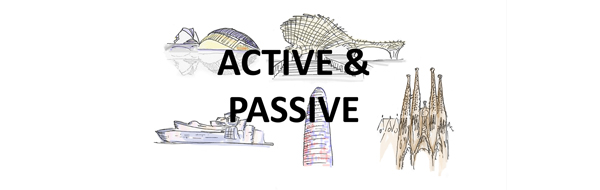
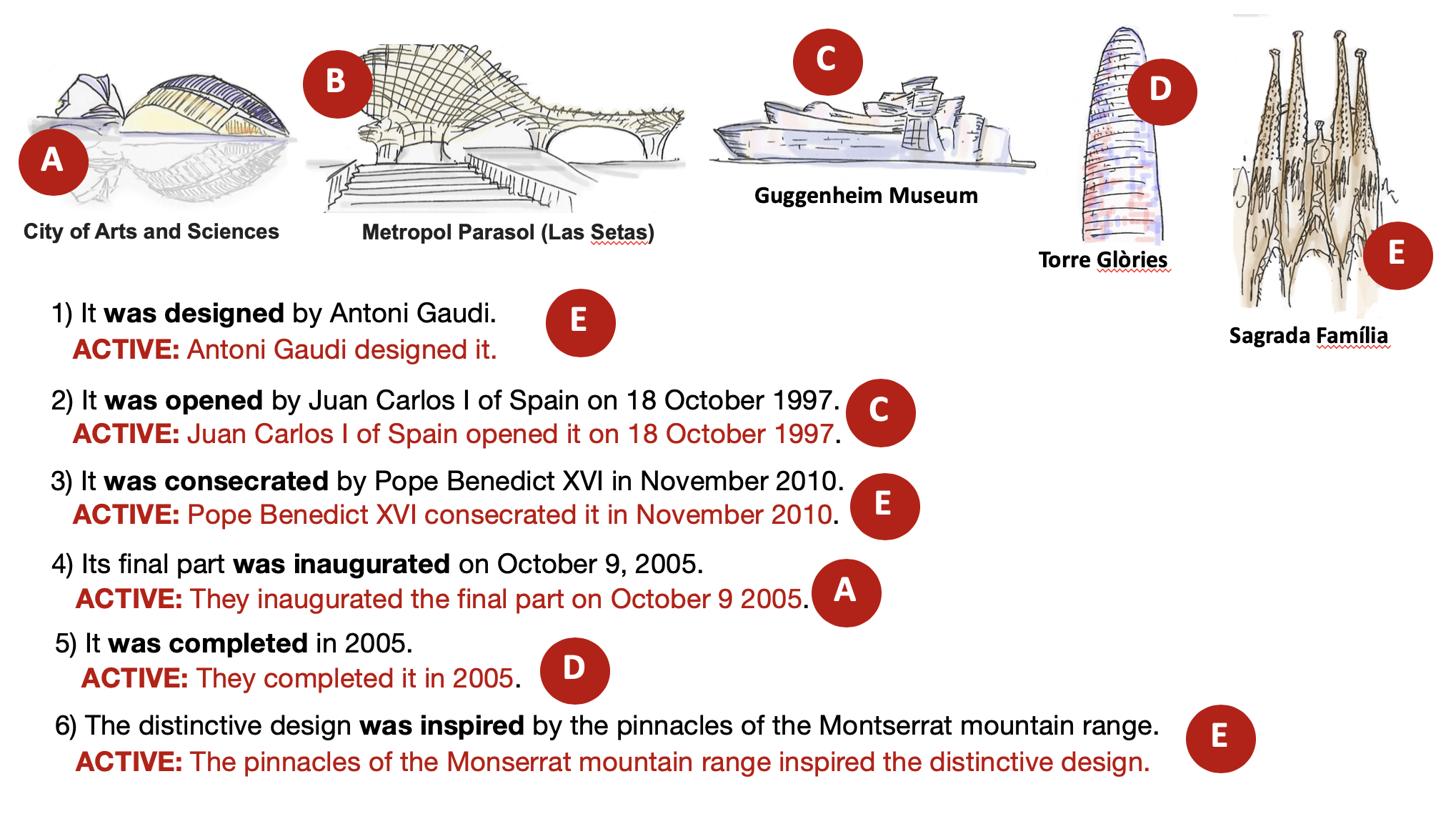
1. Start the powerpoint presentation. Ask the question: “What is the connection between these pictures?” With each slide progression, more of the five iconic Spanish building are gradually revealed. (Buildings are [a]City of Arts and Sciences in Valencia [b]Metropol Parasol (a.k.a. Las Setas) in Sevilla [c]Guggenheim Museum in Bilbao [d]Torre Glòries in Barcelona and [e]Sagrada Família also in Barcelona.)
Rationale: This activates students’ schema (their background knowledge of the lesson topic) and building intrigue and interest in what the lesson will be about.
2. Students can shout out throughout the reveal process, but try to push for the more specific ‘Spanish buildings’ – or even ‘iconic Spanish buildings’ – (rather than just. ‘buildings’). Once the connection is made, ask the students as a class which of these buildings they recognise. (NOTE: many students don’t know Las Setas – and may argue that it is not ‘iconic’ – use this as an opportunity to spark debate about “What building would you include?” Reveal the locations of each building and set up conversation practice. Put class into pairs or groups and ask them to discuss the three questions. (“Ask your partner…” is better than “Tell your partner…” as it will encourage them to listen to each other.)
Ask your partner(s):
– Which of these building have you visited?
– What do you know about these buildings?
– What is your opinion about these buildings?
Rationale: This gives students a chance to have some conversation practice and activates useful vocabulary about buildings and appearance.
.
3. Class feedback: choose student to say which of the buildings their partners have visited. Then ask that partner if they liked it and why. Ask the whole class to offer any facts about the buildings..
Rationale: Taking feedback from students gives purpose to their conversation practice. It also sets up for the next stage of the lesson, where they will discuss facts about the buildings.
4. After taking feedback, tell the class that you know the architects that designed these buildings. Reveal each one (and be open to further comments from students about each). As you reveal each, ensure you (casually) use the passive voice – e.g “The Sagrada Familia was designed by Antoni Gaudi.”
Rationale: Embeds the example of the passive voice in the students minds through repetition.
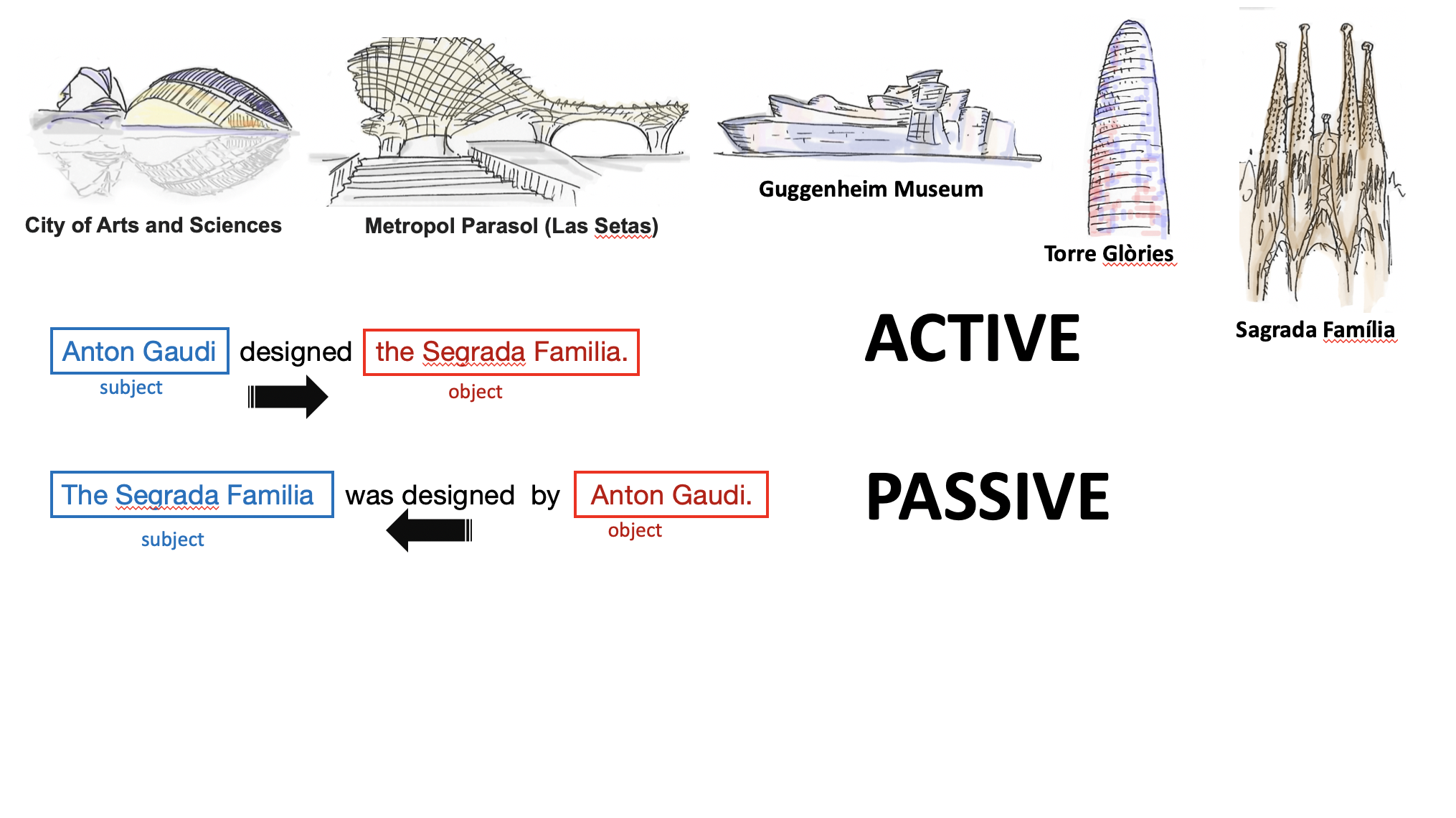
5. Talk through the next slide and introduce the sentence “Antoni Gaudi designed the Sagrada Familia”. Ask them to identify Antoni Gaudi [as the subject] and the Sagrada Familia [as the object]. Point out that – in the active voice – the subject is ‘doing’ the verb to the object.
Point out that you used a different sentences to describe this – see if they remember it. If not introduce the passive sentence “The sagrada Familia was designed by Antoni Gaudi.” Concept check by asking if the two sentences mean the same thing. [They do.] Again ask students to identify the subject and the object. Point out that this time, the verb is happening to the subject.
Rationale: Highlights the difference between the active and the passive voice.
.
6. Move to the next slide. Tell the students that this slide contains facts about some of the buildings. Tell them they are going to complete the sentences in the passive voice. Complete number 1 together (it’s the same as the previous slide). Next quickly check that students know the definitions of the verbs at the bottom of the slide. These verbs are to be used to complete the sentences in the passive.
For any students that finish early, write two extra gap fill questions on the board (but without the missing verb).
Rationale: Students begin to practise forming the passive using the example as a template..
.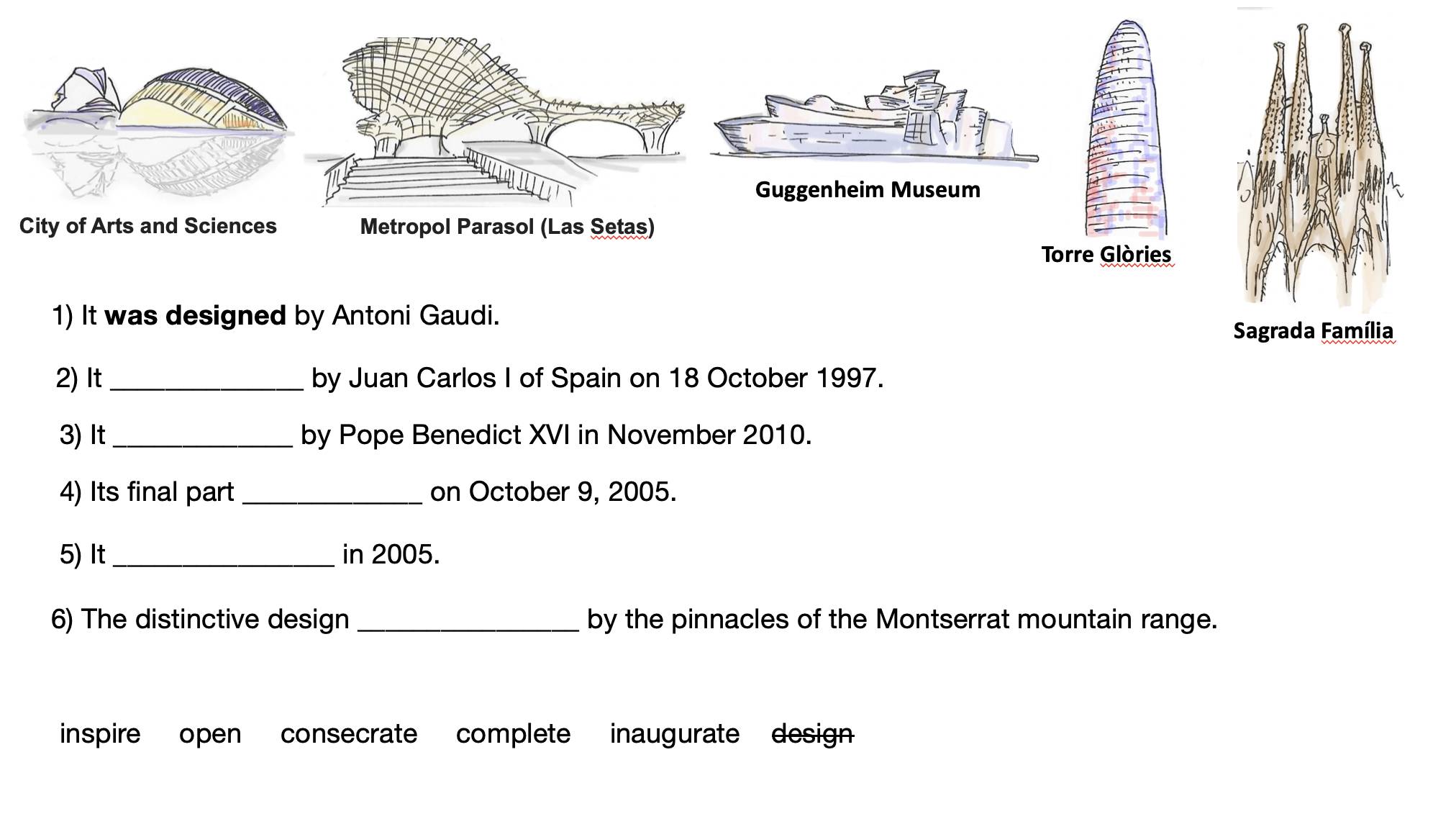
7. Ask students to compare with their neighbours before taking feedback from the class together – completing the powerpoint as you go.
When all the sentences have been completed, go through each asking students to identify the subject and object in each sentence.
Rationale: This highlights that the passive voice doesn’t necessarily need an object..
.
8. Next tell students they are going to convert the sentences into the active voice. Do two examples together as a class – 1 and 5:
1) It was designed by Antoni Gaudi. –becomes–> Antoni Gaudi designed it.
5) It was completed in 2005. –becomes–> ???? completed it in 2005.
Try to elicit who ‘completed it’. (The answer is we don’t know – ‘someone’ did.) Say that in English we usually say ‘They completed it in 2005.’ Use this as an opportunity to highlight that the passive is useful when:
– we don’t know who did something
– it’s not important who did something
Highlight that the passive is useful for formal descriptions.
Rationale: This emphasises the reasons for using the passive..
.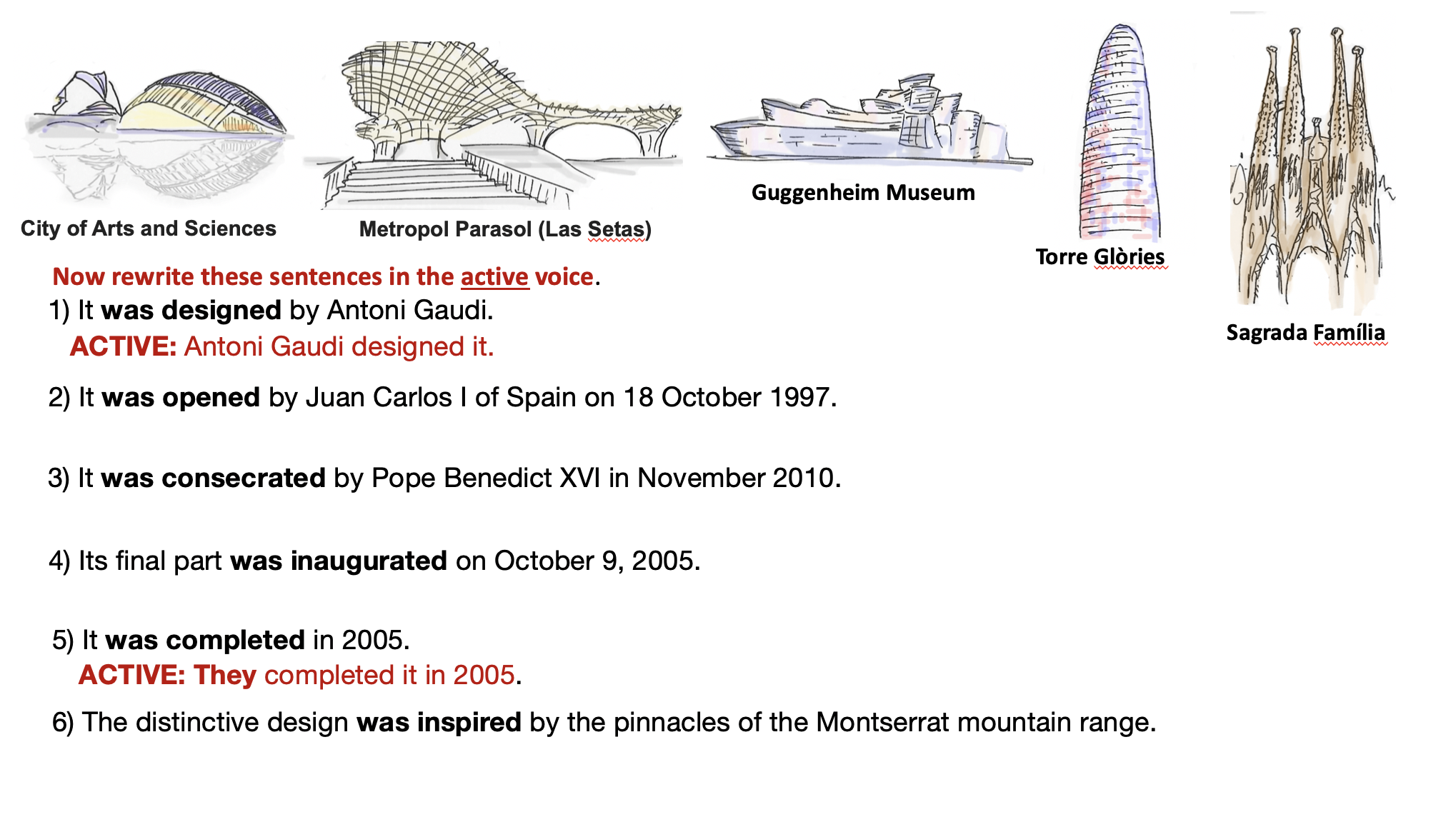
9. Ask students to rewrite the rest of the sentences in the active voice. As students finish, ask them to compare with their neighbours. Finally take feedback from the whole class and reveal he answers on the board.
Rationale: By converting the sentences from passive to active, students have a chance to ‘lock in’ the differences between the two.
10. With any remaining time, ask students to discuss which facts they think relate to which building. They can guess, or use English language wikipedia, if computers are available.
Rationale: Finishes the lesson with an opportunity for further conversation. If using Wikipedia, students will see that the passive is used a great deal.
.
11. At the end of the lesson, display the short-url and QR code that links to a youtube video of the lesson. Invite them to view this in their free time if they wish.
Rationale: Using this, students can review the lesson in their own time to consolidate what they have learnt, or clarify points they may have missed.
.
 TEACHER PETE