
Lesson aims:
To revise the identification and use of countable and uncountable nouns. Students practise by forming the sentences “How many xxxxs are there?” and “How much xxx is there?”
Quick description: In teams, students race to match up 40 English nouns with their Spanish definition, then categorise those nouns as either ‘countable’ or ‘uncountable’. In the final stage, the whole class participate as the online ‘Wheel Decider’ selects a noun, then a student. The selected student has to create an appropriate ‘How many’/’How much’ question to gain their team a point.
Sub-skills practised:
Spelling out names, vocabulary practice
Teaching Materials / requirements:
• Workboards (eg photograph album pages – available from bazaar shops) (1 per team)
• Blutac
• Spanish translation grid (1 per team)
• 40 noun paper slips – individually cut up (1 set per team)
• Red, blue and black whiteboard pens
• An internet connection (to http://www.wheeldecide.com)
(LINK TO WORD SPINNER: https://tinyurl.com/TPIM-countable)
• A projector
DOWNLOAD LINKS: word doc of lesson plan definition grid and noun slips
Preparation:
- Print out the Spanish translation grids (stick pages together to form a single grid sheet for each team).
- Print out nouns and cut-up. Blutac each whole set in a random cloud onto workboards.
- A word document with quick links to the ‘Wheel Decide’ online spinner.
Assumed knowledge:
Students will already have encountered the idea of countable and uncountable nouns, though with such a mixed ability group this knowledge/ability may be weak or non-existent.
Anticipated problems > solutions:
- loss of parts > have a spare set of noun paper slips ready to fill the gap.
- Technology failure > replace the online Wheel Decider by having students write down their names on sheets of paper and put them in a ‘hat’, have a set of nouns already prepared in another ‘hat’.
Lesson plan and rationale:
1. Tell students we’re going to play a game. Divide the class into groups of 3-5, depending on class size. (Option: chose team captains and get them to pick teams.)
Rationale: By making it a team game / competition, students are more engaged and motivated.
2. Get up a blank word document and project it on the board. Go round the class asking each student to spell their name. If any students have the same name, make sure you also include an initial. (Optional alternative: If you have a class list in advance, you can pre-create the Wheel Decider – although be aware that unexpected absences can lead to confusion during the game itself – when names of absent students are selected.)
Rationale: As well as providing some alphabet pronunciation practice, this process gives you a full list of names with which you can create the Wheel Decider.
3. Explain the first part of the game (before handing out the game kits). They have to stick the noun slips into the grid. When the team has finished they must raise their hands.Points are awarded for first place. (In a class of 5 teams, 5 points goes to the first finishers, 4 points to the next, and so on.. Note: I’ve found you don’t necessarily have to explain this point structure, they can work it out as it’s happening.)
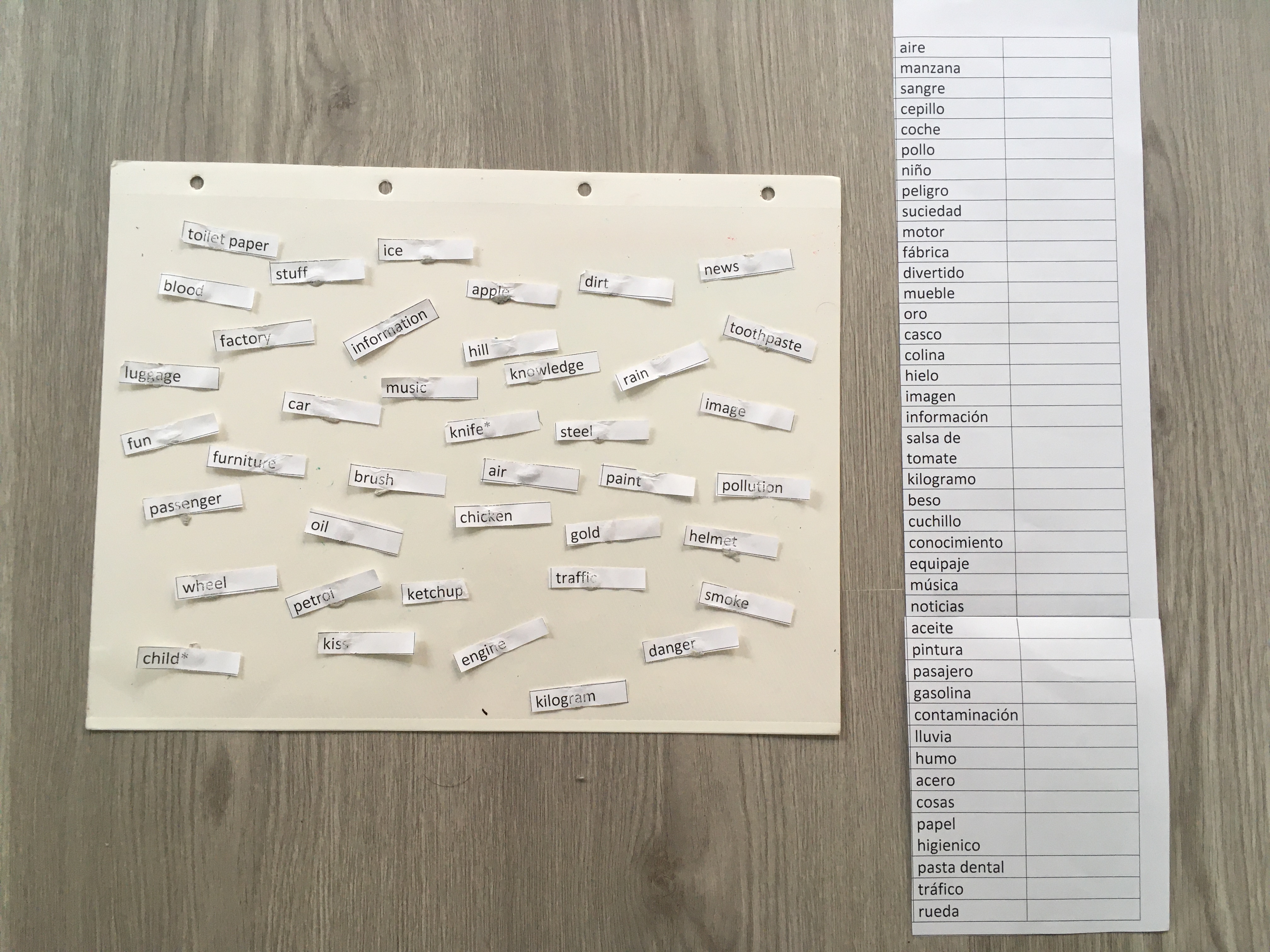
Ask each team captain to come up and collect:
• a workboard with the nouns stuck on them and
• a grid with a Spanish translation of each word.
Rationale: This section ensures that students understand the definitions of the words. Most of them will be familiar to students. Note: it’s possible to adapt nouns to suit a specific vocational subject (eg a mechanics course might include petrol, gas, dirt, steel, material etc).
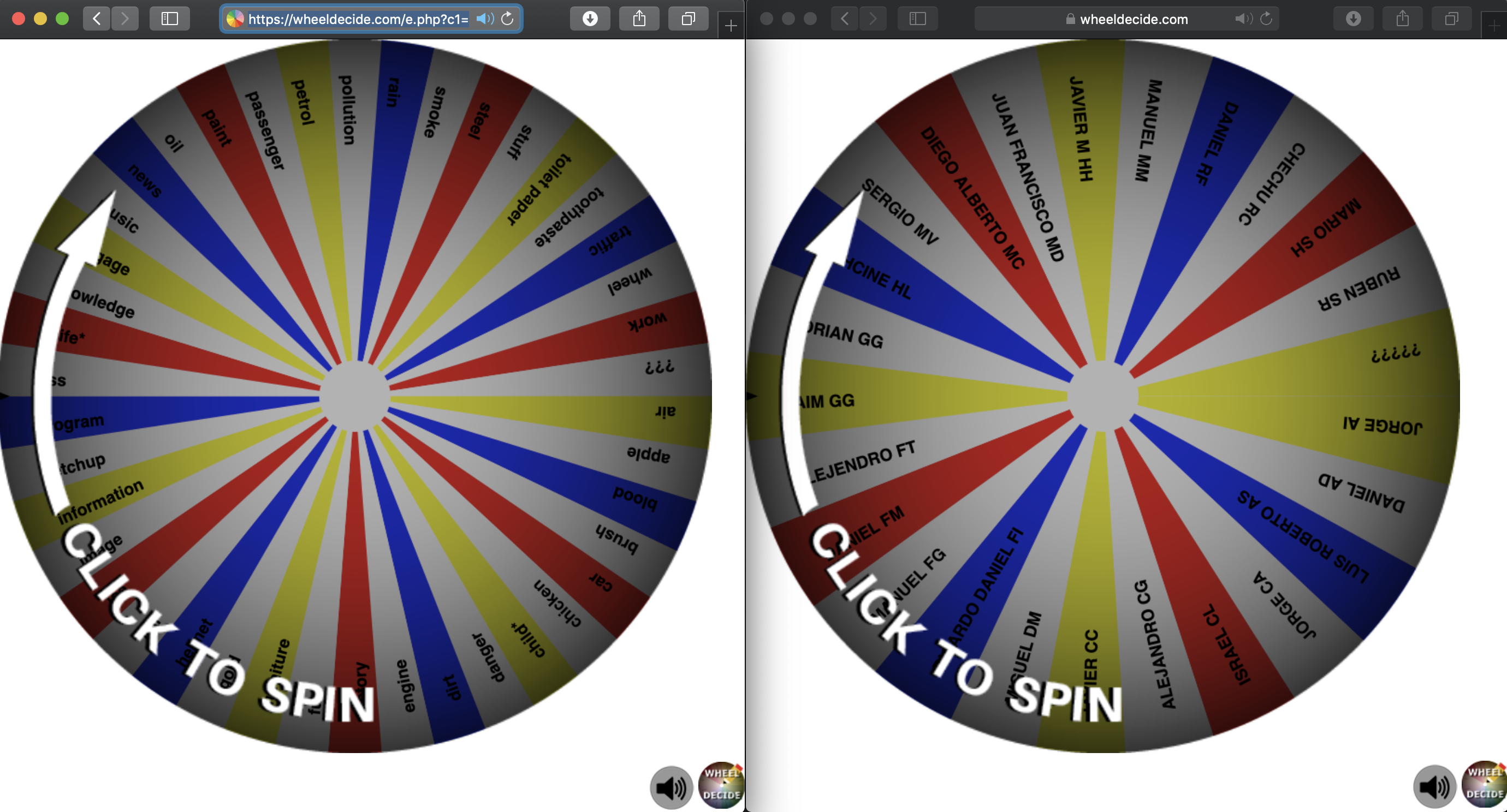
4. As students begin, go round the class to ensure they understand the task. Perhaps demonstrate by placing one noun for them. While they are doing the task, go to www.wheeldecide.com and create a random spinner (to randomly select a name). In a second browser window, retrieve the spinner containing the nouns. (https://tinyurl.com/muchmanyspinner).
5. Go round the class helping the weaker teams a little. (Note: you can decide if you want to allow the students to use their phones as dictionaries during the game.) When a team finishes, check their grid. To make this easier for the teacher (unbeknownst to the students) the English nouns are all in alphabetical order if the students have completed the task correctly. Award the team their points (noted on the whiteboard) and immediately start that team on the next task…
6. As a team finishes their grid, write two headings on their (now empty) ‘noun boards’: ‘Countable’ (in blue) and ‘Uncountable’ (in red). Tell the team to stick each noun under the correct heading.
.

Rationale: this part ensures that student know which nouns are countable/uncountable before being tested in front of the class in the following stage. Builds confidence in their participation.
7. Again, as each team finishes, go over and check. For quick finishers tell them “There are 4 in this column that should be in the other column.” Perhaps denote this on their boards by writing it in whiteboard pen. Leave them to try and correct it.
Rationale: gives teams carelessly quick teams time to rethink. The process of working it out should embed the correct answer more firmly in their minds.
8. As each team finishes correctly, award them their points and tell them to complete (in their minds) the two sentences you have written on the board:
How _______ apple_ ____ there?
How _______ petrol ___ there?
Rationale: this give fast teams a task to do while they wait for the other teams to catch up. You can give extra help to slower teams to keep the lesson moving.
9. When the whole class has finished, as for a solution to the unfinished sentences. Give a point for each. Ask (eg) ‘Is petrol countable or uncountable’. Match the colours to the title heading on the students individual boards (ie countable in blue, uncountable in red.) Draw attention to the plural ‘s’ in the countable example.
10. Leave the two examples on the board. Then turn to the Wheel Deciders. Spin the noun spinner first to select a random noun. Then spin the student name spinner to select a random student. That student must correctly form a ‘How much’/’How many’ question following the template. A correct answer wins one point for their team.
COUNTABLE: How many apples are there?
UNCOUNTABLE: How much petrol is there?
Rationale: By randomly selecting the students using this fun spinner, the students remain engaged. By selecting the noun first, all students are encouraged to think of an answer (just in case their name is selected). Note: the wheel is quite unfair, as it may select lots of people from the same team. But this leads to an extra element of fun / luck.

11. As student get good, wipe off many and more from the board examples. Then later wipe off are and is. Finally collect the boards so that students have no help at all.
12. Just before the bell goes, tot up the scores for each team tally and declare the winners.
 TEACHER PETE